
I love science fiction. I love science fiction so much that I retain a subscription to Amazon TV solely for the comforting knowledge that I could, at any moment and without hesitation, watch the whole of The Expanse end-to-end for a fourth time. I love science fiction, but I am very aware that it is fiction, as in not real. Real science can be inspired by science fiction, but that does not make science fiction a predictor of science.
Over the past few weeks I have been bombarded with messages from various financial institutions about the impending IPO of SpaceX, alongside all the breathless commentary on platforms like LinkedIn. I’m kind of fascinated by it as a perfect encapsulation of the moment in which we live and I want to explore the reasons why.
First there is the length of the S-1. At 200,000 words, which is nearly half the length of War and Peace, I can’t help but think it has been designed not to be read, but to be summarised by an LLM. I mean it was probably largely written by an LLM, so what is more in the spirit of our times than to use an LLM to produce a ridiculous amount of text solely for the purpose of having it summarised by an LLM. However, regardless of how much you pad out the document, you’ve still got to include the disclaimer…
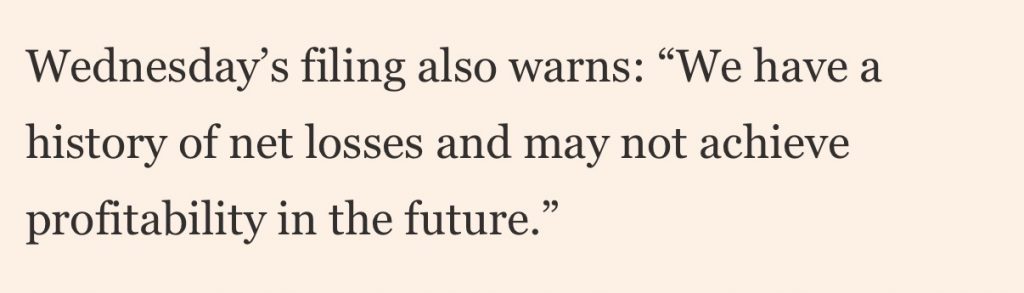
And what a disclaimer it is. It is important to remember that SpaceX has recently become proud owner of xAI, which had almost as recently become proud owner of X (formerly Twitter), which is like taking a giant debt pile and shovelling it into a giant cash fire. Perhaps unsurprisingly there is little mention of Elon Musk’s pet social media platform (at least in the summaries I have seen) which is funny really because in many ways that is what this whole IPO is about, but we’ll come back to that later. Instead, let’s concentrate on the ways SpaceX are aiming to make money for their new shareholders.
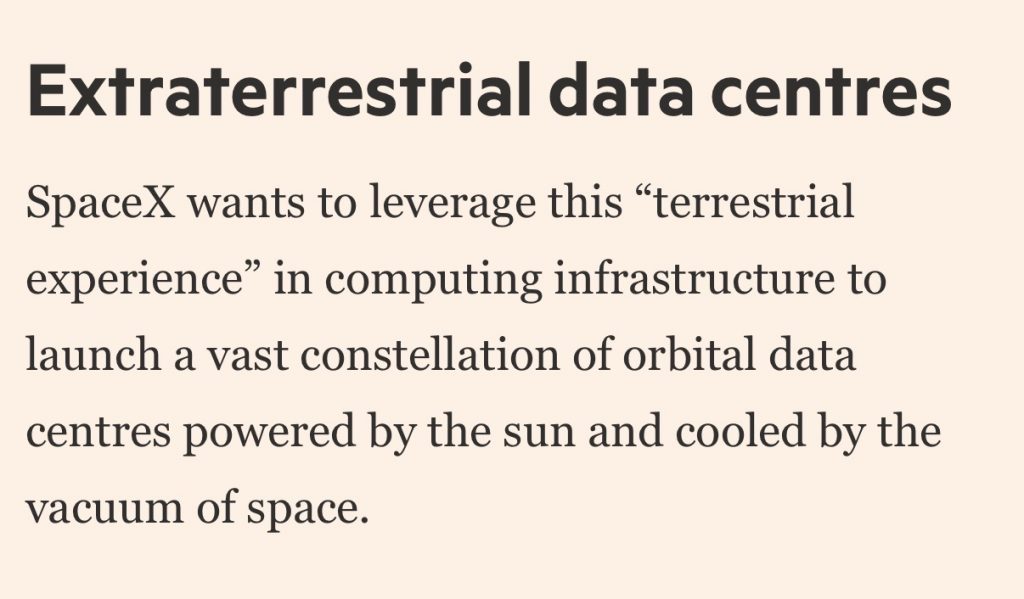
Yes, data centres in space! Cooled by a vacuum! The first objects in history to be able to effectively dissipate heat in a vacuum. You may have heard of a vacuum flask, if you haven’t heard of one, you’ve almost certainly used one: a thermos flask to keep your soup warm or one of those stainless steel mugs that keep your coffee warm. The key thing here is that they use a vacuum to keep things warm rather than cool them. So the basic premise of data centres cooled by the vacuum of space is fundamentally the opposite of what would actually happen. Actual scientists have worked out that in order to cool an orbital data centre you would need cooling fins that would take up several hundred times more space than the servers themselves. And you’ve got to get all that into space where it will get hammered with tiny meteorites, debris and radiation. The average lifespan of a GPU is three years on the ground, what are its chances in space? Who’s going to swap a burnt out GPU? Are they going to fire data centre staff into space every week for maintenance? Is anyone getting the impression that even if this was possible (it’s not) it would be mind-bendingly expensive. What would these orbital data centres be computing? It would have to be something a bit more valuable than Shrimp Jesus. Of course when it comes to AI compute at the moment, no one likes to think too hard about what it’s actually going to do, they are just sure we’ll need ever increasing amounts of it to do ‘everything’ for us (ignoring the fact that it’s really not very good a most of the things you might actually want it to do, and no, that’s not going to change). This is the logic that drives a belief in the economic sense of trying to shoot warehouses full of expensive and temperamental computer equipment into space: that somehow the sheer volume of extra compute needed will make it economically viable. And you can believe this as long as you don’t do even the most cursory napkin maths. And yet the hyperbole just keeps on pouring in from the ‘professional investors’.
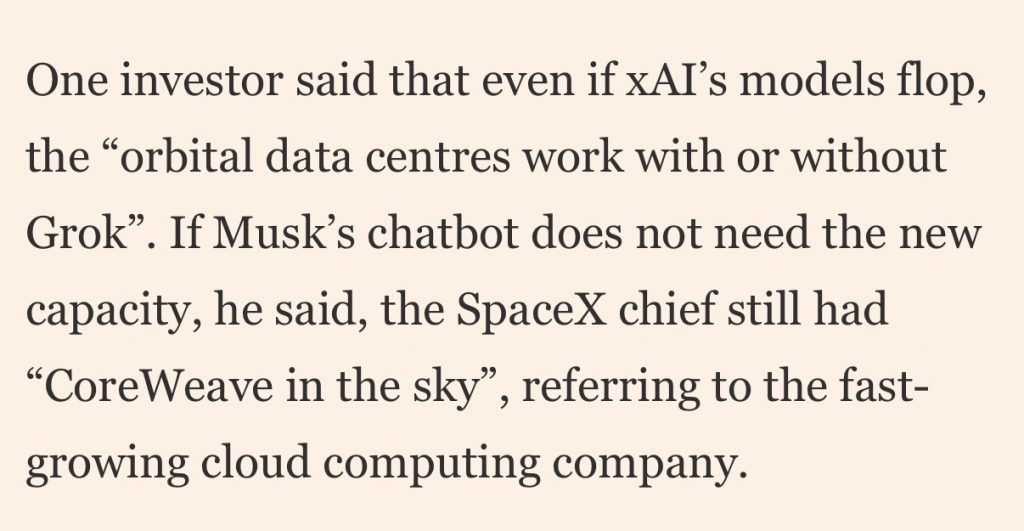
Hilariously, this particular statement may prove to be very accurate, just not in the way they mean. Because, despite their spectacular market performance and their many gigawatts of ‘commitments’, CoreWeave have yet to actually build a new AI data centre. In this respect, SpaceX could very well be the space equivalent of CoreWeave: a company promising massive data centre capacity whilst delivering almost none.
Of course space data centres look comparatively achievable when taking into account the other possible scenarios in which Musk’s new shares would vest, namely a colony of a million people on Mars. This is categorically not going to happen. I’m not even going to bother detailing the hundreds of reasons why, but suffice to say SpaceX would need several orders of magnitude more money than they will raise from this IPO to sustain a thousand people on Mars, let alone a million.
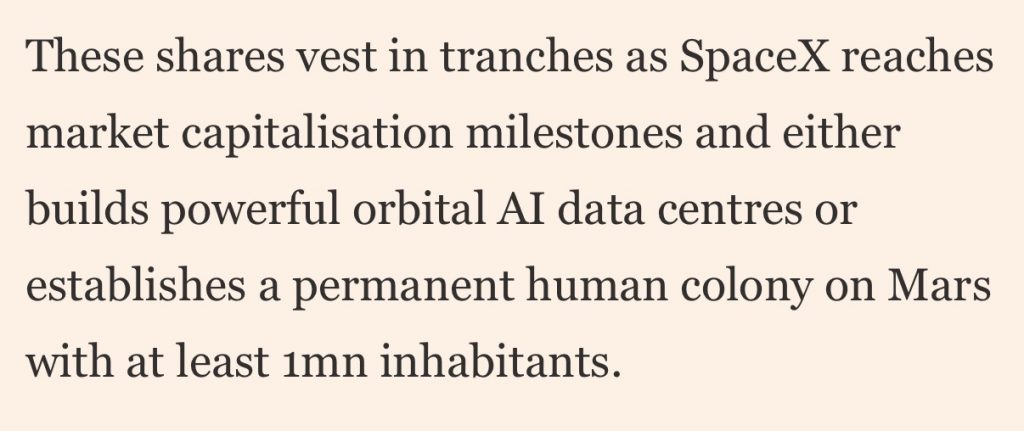
Of course all this assumes Musk cares about the shares vesting, which I would posit he doesn’t. What he wants is never to be fired again. Musk has bad form with public companies, he hates being beholden to shareholders, not least because they have a habit of firing him (Tesla is the exception, for now). If he really must take SpaceX public, he wants to make sure those annoying investors whose money he needs can’t get rid of him if he doesn’t deliver a return on their investment.
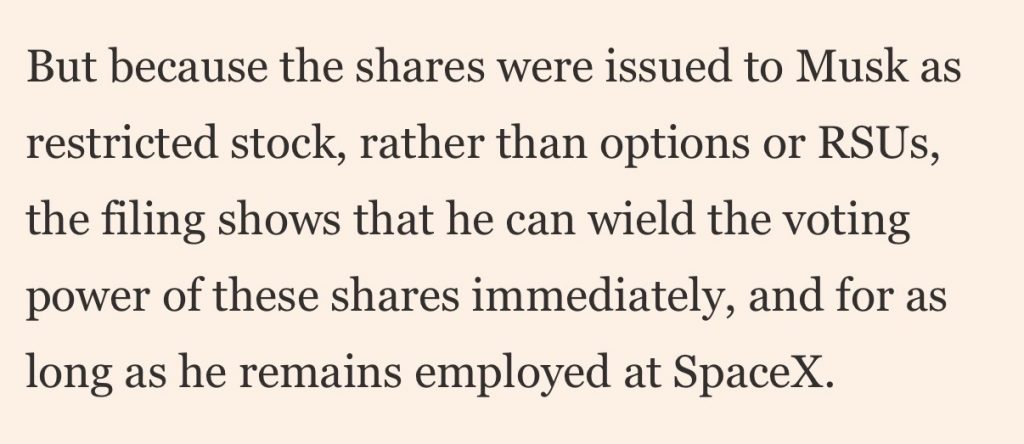
This is more likely than the hype would have you believe. Of SpaceX’s divisions and subsidiaries, only Starlink currently makes a profit and much of SpaceX’s revenue comes from launching Starlink satellites. So maybe here we could see a path to overall profitability, except for the fact that there is a hard limit on Starlink growth.
Starlink is by all accounts a good consumer product. If you’re in a remote location it provides good quality internet connectivity that would otherwise be unavailable. The problem here is that, by definition, most of the world’s population are not in remote locations. I suppose Starlink could try to undercut urban fibre services, but the economics of this don’t really bear out either. Starlink satellites have a five year lifespan, so that’s a cost model barely better than (ground based) AI data centres. But at least it’s guaranteed income for the launch business. So Starlink gives some stability if not much growth. Investors spending this much money want growth, so I guess we look elsewhere.
Funnily enough whilst I was writing this Anthropic announced their decision to go public with an IPO and then, of course OpenAI did the same. I’ll leave the OpenAI filing aside for now and concentrate on the circumstances around the Anthropic IPO. Not surprisingly shortly before the announcement there was reporting that in Q1 2026, Anthropic had massively increased its revenue with at least one report stating that they might actually be in profit for the first time (although this is only true if you ignore their actual costs). This is obviously exactly the kind of news a company would want immediately before listing on a stock market, and seemingly miraculous given the company’s estimated losses to date. Interestingly, this revelation comes at a time when a whole bunch of quite senior technology figures are openly questioning the value of their massive ongoing investments in LLMs, with several noting they have already blown through their annual token budget. How did these people get their budgeting so wrong when their teams have presumably been using AI at something like this scale for a year or two already? Just after the start of the year, Anthropic changed its pricing from a rate limited monthly fee to a per token based model. This means that its customers have switched from a heavily subsidised pricing model to something like the real cost of inference*. In the short term this massively increased Anthropic’s revenue, in the barely-more-than-short term this is causing Anthropic’s customers to question the value of their AI spend** and keep a much tighter reign on it, thus reducing Anthropic’s revenue again. So Anthropic may well be at peak revenue, although I’m absolutely sure that’s not what their S-1 will suggest.
One of the justifications for the belief in SpaceX’s potential for growth in AI infrastructure is the fact that it has recently leased some of its spare data centre capacity to Anthropic. We’ll gloss over the fact that xAI only have this spare capacity due to lack of demand for its own AI products, and instead look at the fact that this is probably the peak of Anthropic’s demand (especially as some of the capacity that’s supposedly being built for them directly or by other hyperscalers comes online). From this perspective it looks less like the start of a rocket trip to mars and more like apogee of starship’s recent test flight.
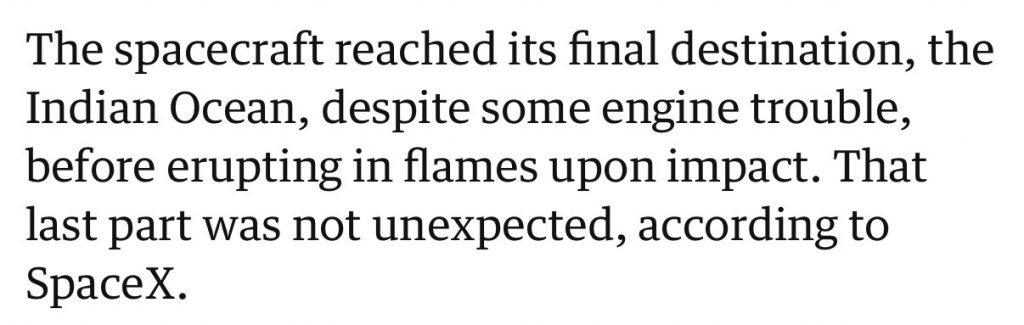
That launch just days after the S-1 was released was clearly intended to demonstrate that the stars and all their untapped wealth are within reach. To me it feels like Anthropic’s revenue data: a bit shaky and inconclusive. Certainly not the kind of thing to inspire confidence that I’d see any return on any part of the gargantuan investment these companies are expecting from their IPOs. Of course it doesn’t really matter what I think, or really what anyone else thinks about the viability of these companies, as the investment is pretty much baked in. One of the key features of the SpaceX (and probably Anthropic and OpenAI) IPO is the change in rules around when they will be included in indexes (and therefore in the blended index funds used by most ‘retail’ investors) and when major stockholders can sell their holdings.
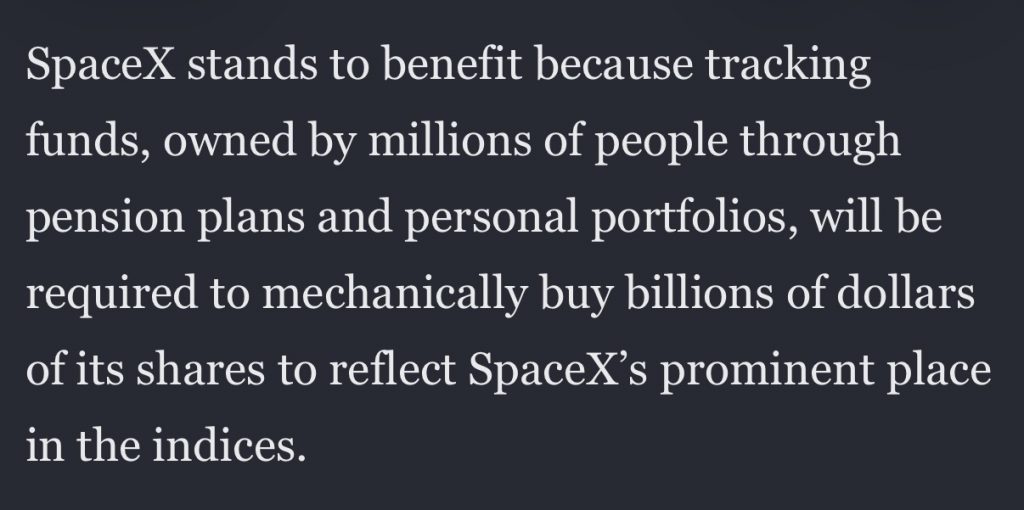
This will mean the market will not have ‘tested’ the true value of these stocks before index funds have to buy them, creating a bump in prices for the major investors looking to realise the investments they made in these wildly unprofitable companies at the start. A more cynical person might think that this was all just a way for financial institutions and VCs to make money offloading their bad investments (most notably the vast sums of money they lent Elon Musk to buy Twitter) on the public. I couldn’t possibly comment.
So what makes this feel so indicative of the moment in which we live? Here’s my AI friendly list:
- documents written by AI to be read by AI ✓
- wild claims about what a company’s technology might be able to do in future with no evidence that future is very near or even reachable ✓
- an astronomical price to earnings ratio ✓
- rules being changed to benefit the big guys ✓
- with the little guys picking up the costs ✓
- an investment strategy based on FOMO ✓
And really this last bit is how things work now. SpaceX will become another meme stock, much like Tesla, although with possibly even less real potential to turn a profit. But that stuff doesn’t really matter. As long as you can keep the FOMO going people will keep putting their money in, hoping they’ll be the ones to cash out at the right time. Gradually the global economy will be turned into a cross between a casino and a Ponzi scheme, and we all hope we won’t be the ones holding the bag when the music stops. Except of course, as always, most of us will be.
In a way the SpaceX IPO could be viewed as a form of wealth tax, except instead of being levied on the wealthiest, it is levied on the wealthy-ish. Not that this community can’t afford to spare a little, but they might prefer to be able to decide what their money is spent on. In the traditional model of tax, we are supposed to vote for the government that is going to spend our money how we want. Again, Musk thinks this is inefficient and that people should let him decide how to spend their money. He managed to get $17 billion out of the US taxpayer without too much direct intervention, but when that looked in jeopardy then he tried to buy the government to make sure that he could guarantee his tax take. However, politics is hard to control even if you are the richest person in the world, so why not find another way to tax the people, avoiding all those unhelpfully democratically elected bodies. It seems like he’s found it. At this point the defence of the ‘free market’ is that this isn’t really a tax because the market will correct it, except of course that we know shareholders now have no power over Musk and most of the people who will become ‘investors’ have no power to ‘vote with their wallet’ unless they want to exit the mechanism that they’ve been told for years is the way that they can guarantee a decent retirement. So this is effectively a dictatorship that has the power to wield global taxes on peoples’ retirement funds. And just like any other tax, the only real way to get out of paying it is be too poor to have enough to be taxed or be rich enough to avoid paying it.
So I guess two more things to add to the list of nowness:
- Subversion of democracy ✓
- Global wealth tax (just not the kind you thought) ✓
All of these things are the sorts of things that might crop up in science fiction, it’s just a shame that only the rubbish bits will ever be anything other than fiction.
*inference is the process of getting a model to generate output text in response to input text
**after all what’s the point in spending money on an unaccountable machine when it’s more expensive than much more accountable human beings
Leave a Reply